
Market value indication
For a straightforward building plot with a suitable data basis, a first approximate assessment can make sense.
Learn more →
With a plot of land, the area matters less than what is permitted on it. That is exactly what I check first. Only then do square metres become a value.
Jens Krüger · Let’s talk: +49 172 868 5666
The value of undeveloped land is not determined by its area and the standard land value alone. What matters first is which use is legally and actually possible and what stage of development the land has reached. As a land valuer, I assess these questions – from a first market value indication to a detailed valuation report for a plot.
I value, among others, residential, commercial and industrial plots as well as agricultural and forestry land.
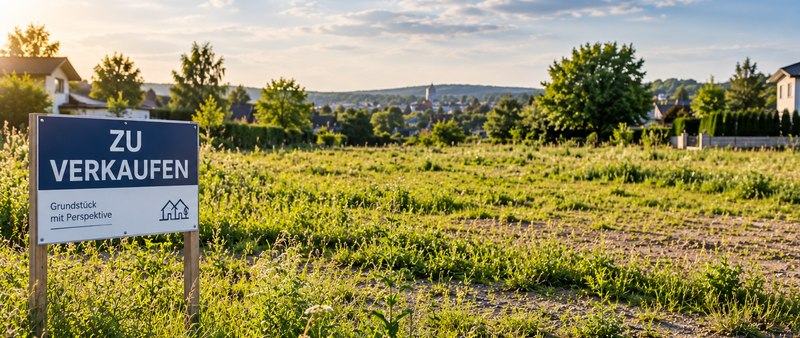
For the valuation, it first has to be established which stage of development the land belongs to. A plot of serviced residential building land has to be assessed differently in economic terms from unserviced building land, prospective building land or agricultural or forestry land.
Serviced building land (baureifes Land) comprises land that can be built on under public-law provisions and the actual circumstances. Unserviced building land (Rohbauland) is in principle designated for development but is not yet ready for building, for example in terms of servicing or plot configuration. With prospective building land (Bauerwartungsland), specific facts give rise to a sufficiently certain expectation of future development, although the land is not yet ready for building.
Assigning the stage of development is therefore a key basis for determining land value.
If there is a local development plan (Bebauungsplan), its provisions on the type and density of permitted use and other building requirements are of central importance.
In built-up areas without a development plan, planning permission for a project is generally governed by § 34 of the German Building Code (BauGB). The key question is whether the project fits into the character of its immediate surroundings according to the statutory criteria.
Different requirements apply to land in the outlying area (Außenbereich) under § 35 BauGB. A plot is therefore not building land simply because it would be technically conceivable to build on it.
The property valuation takes into account the use that is permitted under planning law or sufficiently secured as a plot characteristic affecting value. It does not replace a binding planning decision.
The standard land value relates to a reference plot with certain characteristics. The specific plot being valued may differ from it, for example in size, shape, depth, type and density of permitted use, stage of development or liability for development charges.
Such differences may require a property-specific adjustment. The relationships, including the importance of model consistency, are explained in the guide standard land value & land value.
Where a sufficient number of suitable sale prices is available, actual sales of sufficiently comparable plots can be an important basis for determining land value. Information from the purchase price collection of the competent local valuation committee (Gutachterausschuss) can be used for this purpose.
What matters is that the comparable cases are sufficiently similar in their characteristics affecting value and suitable in time for the valuation date. Not every existing transaction is therefore automatically a suitable comparable price.
Road access and utilities can already be important for assigning the stage of development. It must also be examined whether the plot is still liable for development charges and whether further servicing or other charges or costs affecting value are to be expected.
Terms such as “partly serviced” are not sufficient on their own for the valuation. What matters is which servicing infrastructure is actually in place or secured and what economic consequences this has for the specific plot.
Plot size, width and depth, shape, topography, access and possible subdivision can influence how the land can be built on and used economically. The type and density of permitted use or possible additional buildings can also affect value.
With oversized plots in particular, it must therefore be checked whether the whole area can be used to equal economic effect. Simply multiplying the total area by a standard land value can lead to an incorrect result.
Suitability of the ground for building, soil contamination or known contaminated sites can also affect value. However, the land valuation does not include a geotechnical or environmental investigation of its own. Existing information and specialist reports are taken into account within the scope of the specific task.
With agricultural land, the type of use and soil quality can play a particular role alongside location, size and shape. Existing information, for example on the quality of arable land or grassland, can therefore be relevant to the valuation.
With forestry land, the standing timber is an additional factor. Land and growth have to be distinguished properly. Tree species, age, stand structure and existing forestry data can be important for valuing the stand.
A forest inventory of my own is not part of the property valuation. If a more detailed valuation of the standing timber is required, corresponding forestry documents or additional specialist information may be needed.
For a straightforward building plot with a suitable data basis, a first approximate assessment can make sense.
Learn more →For a clearly reasoned valuation with a property-specific investigation and – where necessary – a site inspection. The scope and fee depend on the case.
Learn more →For complex plots, special stages of development, rights or demanding planning law questions, a comprehensive valuation may be required.
Learn more →When a suitable earlier land valuation already exists and valuation inputs are to be traced or updated to a later valuation date.
Learn more →Depending on the plot and the instruction, the following are particularly helpful:
Not all documents need to be complete at the first enquiry. Further valuation data – such as suitable comparable prices from the purchase price collection – is obtained during the work, where required for the case and available.
I carry out site inspections from my offices in Dresden, Berlin and Lemgo.
Tell us the location, size, use and reason for the valuation. We will clarify in advance which type of valuation fits, and you will receive a specific price before placing the instruction.