
Market value indication
For a first approximate assessment based on the property, rent and market data available.
Learn more →
With an apartment building, income is what counts in the end. I assess rents, operating costs, condition and remaining useful life together – the way the market assesses such a building.
Jens Krüger · Let’s talk: +49 172 868 5666
For apartment buildings, floor areas and sustainably achievable rents are among the key value drivers. For a proper valuation, however, they have to be considered together with the plot, the tenancy structure, operating costs, condition, remaining useful life and conditions in the local property market. As an expert, I examine these relationships for the specific property – for an inner-city rental building as much as for a residential complex on the edge of town.
The focus is generally on the property’s sustainable income potential – not simply on the total of the rents currently agreed.
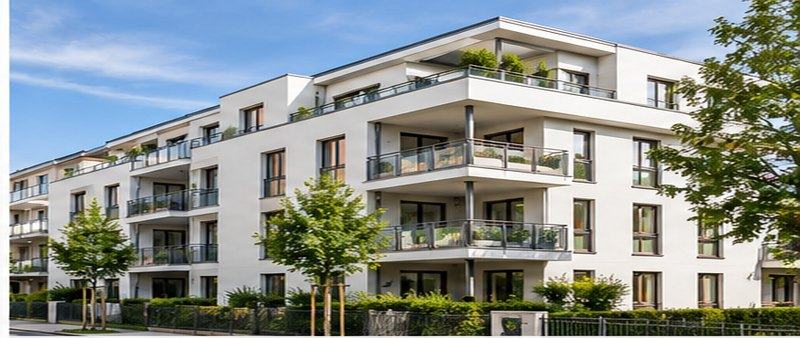
With apartment buildings, the focus is generally on the property’s sustainable income potential. What matters is therefore not only which rents are currently agreed, but which income can be assumed on a sustainable basis, taking into account the specific property and the local property market.
Particularly relevant may be the current net rents excluding service charges, lease start dates and rent development, flat sizes and unit mix, let and vacant units, parking spaces and garages and other let areas. Differences between contractual rents and market rents can also matter for the valuation.
The tenancies are considered from a valuation perspective; this does not replace a review under tenancy law.
In the income approach, the operating costs to be applied in line with the valuation model are taken into account. Depending on the model, these include in particular management costs, maintenance costs and the risk of rent loss, and where applicable other non-recoverable costs.
Which inputs are appropriate depends on the property, the valuation model and the relevant property market data.
For apartment buildings, the income approach (Ertragswertverfahren) is generally a key valuation method. Put simply, it examines what sustainable income can be expected from the land and building and how this income is to be capitalised, taking into account the remaining useful life and a market-based property yield (Liegenschaftszinssatz).
The property yield cannot be chosen freely. Where suitable property market data is available, it must be applied consistently with the model from which it was derived. On the importance of model consistency, please see the guide ImmoWertV & ImmoWertA.
The standard land value is not automatically the same as the land value of the specific plot. Plot size and shape, type and density of permitted development, servicing and other characteristics affecting value may have to be taken into account. With larger plots, the existing or possible level of development can also play a particular role.
The basics and distinctions are explained in the guide standard land value & land value. Rights affecting value such as a right of residence or usufruct and heritable building rights may also have to be taken into account, depending on the property and the task.
With an apartment building, the state of modernisation and foreseeable capital expenditure can have a considerable influence on the economic assessment. The roof, facade, windows, heating system, pipework, electrical installation, staircases and balconies, among others, can affect value. The expert valuation does not replace a full technical building survey.
Living and usable areas are also a key basis of the valuation. Incorrect area figures can affect both the rents applied and comparison ratios. If there are doubts about existing figures, a separate floor area measurement may make sense.
A flat that is empty between two tenancies has to be assessed differently from a unit that cannot be let in the long term or from structural vacancy. Temporary vacancy may also be related to modernisation or re-letting.
For the valuation, what matters is therefore not only that a unit is vacant, but why it is vacant, how long this is likely to last and what sustainable use or lettability can be expected in the market.
Attic conversion, additional building potential, changes of use or other development potential can affect value. However, they should not be included in the valuation merely because they are theoretically possible.
What matters is whether the potential can be assessed with sufficient certainty in legal, structural and economic terms. Unsecured hypothetical floor space is therefore not treated in the same way as existing usable or lettable space.
For a first approximate assessment based on the property, rent and market data available.
Learn more →Depending on the size of the property and the task, a valuation with more compact documentation can be agreed individually.
Learn more →For a comprehensive investigation, derivation and documentation of the market value. For apartment buildings, the scope and fee are calculated individually.
Learn more →For apartment buildings, the scope of a pre-purchase consultation or pre-acquisition assessment is agreed individually according to the property and the task – with a view to purchase price, income, condition and investment needs.
View pre-acquisition assessment →When existing living, usable or lettable areas are to be checked or recalculated.
Learn more →Depending on the property and the instruction, the following are particularly helpful:
For larger or more complex properties, further documents may be required depending on the task. Not everything needs to be complete at the first enquiry.
I carry out site inspections from my offices in Dresden, Berlin and Lemgo.
Send us the key data, the tenancy schedule or rent roll (if available) and the reason for the valuation. After reviewing them, you will receive an individual quotation before placing the instruction.