
Market value indication
For a first approximate assessment where the property, income and market data basis is sufficient.
Learn more →
With commercial property, what counts is what the property can earn on a sustainable basis. Supermarkets, a car dealership, a guesthouse: each property raised its own questions. We start by clarifying the use and the purpose of the valuation.
Jens Krüger · Let’s talk: +49 172 868 5666
With commercial property, value depends largely on the use for which a property is designed, which income can be achieved sustainably and how well the property could be used for something else if market or occupier requirements change. As an expert, I therefore first establish which use and which market the property is suited to.
The range includes office, medical practice, retail, restaurant and hotel property, small and medium-sized warehouse and logistics properties and other commercially used property.
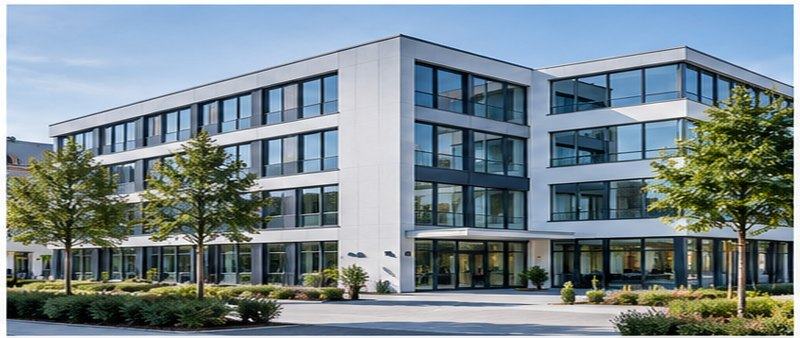
An office building, a medical practice, a restaurant, a hotel or a retail warehouse can belong to completely different sub-markets despite a similar floor area. For the valuation, it is therefore first necessary to understand which use the property allows, which group of occupiers it appeals to and what the relevant market requires in terms of location, building and specification.
Whether the property was mainly designed for a single occupier or is divided into several independently usable units can also matter for marketability and the assessment of risk.
From my valuation practice: the commercial properties I have valued include restaurants and other food and beverage premises, supermarkets, a car dealership, workshops and a former furniture store with a large sales area. With restaurants and retail in particular, the rent or lease payment of the current operator often differs from what can be achieved sustainably at the location. For the valuation, the market income is generally what counts; deviations arising from the existing lease are taken into account separately.
For retail space, visibility, customer footfall and passing trade can be key location factors. For office property, accessibility, public transport, parking and the surroundings can be more important. Medical practices in turn have their own requirements, for example regarding accessibility; for warehouses, transport links, delivery access and the plot situation can be decisive.
The quality of the location is therefore always assessed in relation to the specific or sustainably possible use.
With let commercial property, rent level, lease term, renewal options, indexation or stepped rents, the service charge structure and the specific type of use can be of economic significance. A long-term lease may be above or below the current market level.
For the valuation, the specific lease situation and sustainable market conditions are therefore considered together. Lease terms are taken into account insofar as they are relevant to the economic valuation; a legal review of the commercial lease is not part of the property valuation.
The more a commercial property is tailored to a particular occupier or operating process, the more important the question of what adaptations would be needed if the occupier changed.
Layout, technical equipment, ceiling heights, access, accessibility, parking, delivery access and the use permitted under building law can influence the potential for alternative use. Flexibly usable space may be assessed differently in the market from a highly specialised property with a limited range of occupiers.
Vacancy in a commercial property may have to be assessed differently from residential vacancy. What matters in particular are the cause and duration, demand in the relevant sub-market, the potential for alternative use and whether conversion works or other adaptations are needed before re-letting.
A flat-rate reduction in value based solely on current vacancy would therefore not be appropriate. What counts is the economic assessment of the specific case.
For income-producing commercial property, the income approach can be a key valuation basis. Sustainable income, operating costs, remaining useful life and the property yield or other suitable property market data must be applied consistently with the model.
With commercial property in particular, it is decisive whether the available market data actually fits the subject property in terms of type of use and structure. The guide ImmoWertV & ImmoWertA explains more about model consistency.
Plot size and shape, servicing, parking provision, development density and any expansion options can be key factors for commercial property. The standard land value is not automatically the same as the land value of the specific plot. The basics are explained in the guide standard land value & land value.
Usable and lettable areas are also key valuation inputs. Which definition of floor area is needed for the specific instruction depends on the property and the task. If there are doubts about existing figures, a separate floor area measurement may make sense.
For a first approximate assessment where the property, income and market data basis is sufficient.
Learn more →Depending on the property and the task, a valuation with more compact documentation can be agreed individually.
Learn more →For a comprehensive investigation, derivation and documentation of the market value. The scope and fee are calculated individually.
Learn more →For commercial property, the scope of a pre-purchase consultation or pre-acquisition assessment is agreed individually according to the property and the task – with a view to purchase price, income, condition and investment needs.
View pre-acquisition assessment →When existing usable or lettable areas are to be checked or recalculated.
Learn more →Depending on the property and the instruction, the following are particularly helpful:
For more complex commercial properties, further documents may be required depending on the task. Not everything needs to be complete at the first enquiry.
I carry out site inspections from my offices in Dresden, Berlin and Lemgo – and, for commercial and industrial property, further afield too.
Briefly describe the use, floor areas, letting situation and reason for the valuation. After reviewing the task, you will receive an individual quotation before placing the instruction.